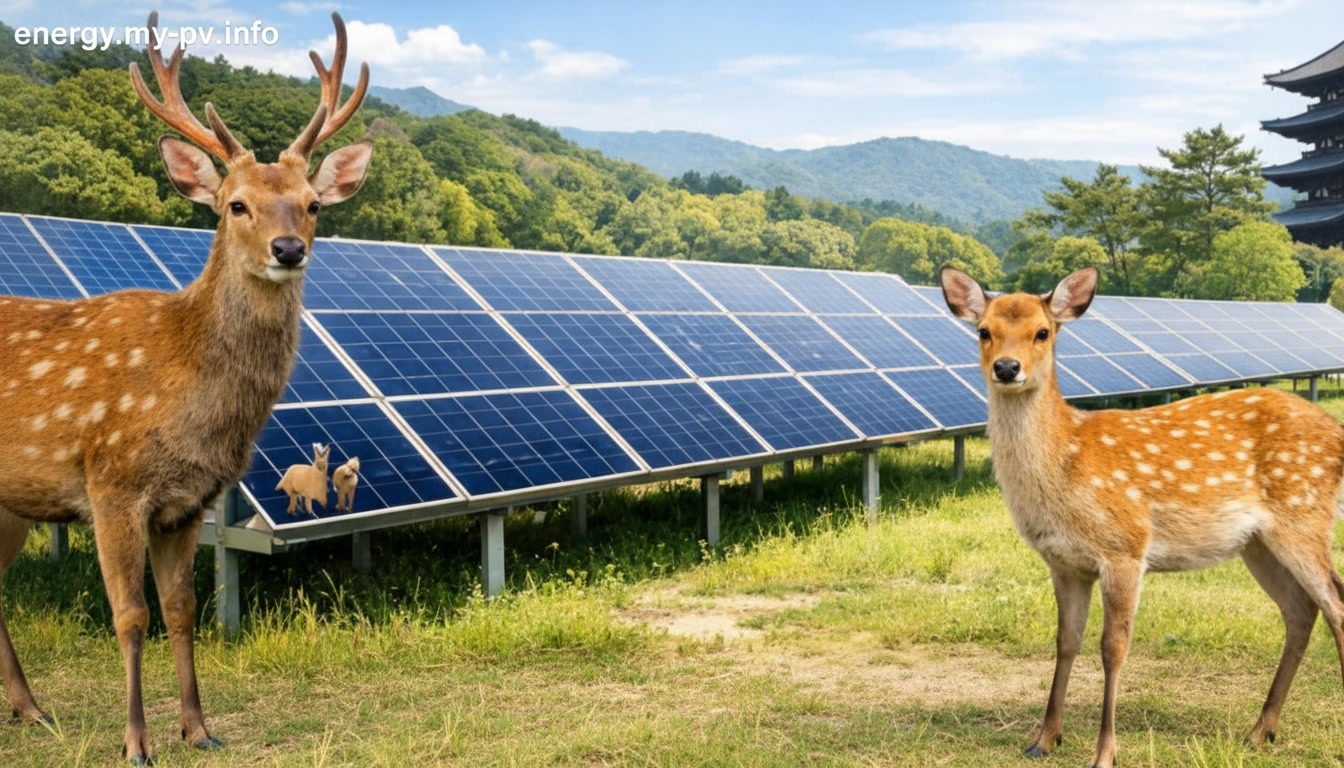
Nara deer standing beside solar panels with a Japanese pagoda and forested hills in the background
Solar Research Station · Nara, Japan

The Effect of Solar Stations
on Deer Habitats

Monitoring wildlife behaviour, habitat adaptation,
and ecological balance within photovoltaic zones.

Scroll
3.2 MW Capacity
47 Deer Observed
98% Coexistence Rate
4 Study Seasons
Research Focus

Where renewable energy meets ancient wilderness

The Nara solar station study examines how photovoltaic installations integrate with one of Japan's most iconic wildlife sanctuaries. Sika deer have roamed these lands for over a thousand years — our work asks whether solar energy can share that space without disruption.

01

Shade Ecology

Solar panels create shaded microhabitats beneath them. Deer use these zones for thermoregulation during hot summer months, reducing heat stress by up to 4°C compared to open grassland.

02

Grazing Patterns

Vegetation grows differently under and between panels. We track how deer adjust foraging routes, finding consistent preference for the denser grass corridors between panel rows.

03

Behaviour Analysis

Motion sensors and camera traps log 24/7 activity. Initial fear responses to panel installation subsided within 6–8 weeks — deer now treat the structures as neutral landmarks.

04

Energy Output

Deer-induced soiling and panel shading are monitored in real time. Surprisingly, deer activity has negligible impact on generation efficiency — less than 0.3% annual yield reduction.